


Discover how optimal resource allocation enhances operational capabilities, minimises downtime and improves performance across complex administrative processes.
Rethinking Administrative Complexity in Modern Organisations
Administrative operations have grown increasingly complex as organisations scale, diversify and adopt new digital tools. What were once straightforward support tasks now involve multiple systems, approval layers and stakeholders, making it harder to maintain efficiency across day-to-day operations. Without careful coordination, even routine requests can become time-consuming and difficult to track.
These challenges often surface in the form of fragmented task flows, duplicated efforts and unclear ownership. When administrative work is spread across teams without a clear structure, organisations risk slower turnaround times and rising operational friction. Achieving optimal resource allocation in such environments requires organisations to rethink how administrative work is designed, governed and supported.
Identifying Bottlenecks That Undermine Efficiency
Many inefficiencies in administrative processes stem from unnecessary handovers and poorly defined responsibilities. Tasks may pass through multiple teams for review or approval, even when the added value is minimal. Over time, these handovers accumulate, creating delays that are difficult to resolve without a holistic review of the process.
A lack of visibility further compounds the issue. When teams cannot easily see request status, priorities or dependencies, follow-ups increase and work becomes reactive. Identifying these bottlenecks is a critical first step towards optimal resource allocation, as it highlights where effort is being consumed without delivering meaningful outcomes.
Optimising Resource Allocation Through Smarter Workflows
Optimal resource allocation is not about doing more with less, but about deploying the right capabilities at the right point in the process. By mapping administrative workflows end to end, organisations can identify tasks that can be streamlined to reduce unnecessary effort.
Workflow innovation plays an important role in enabling optimal resource allocation at scale. Simple changes such as standardising request formats, clarifying decision thresholds or reducing approval layers can free up valuable time and capacity. When workflows are designed with intent, teams are better positioned to focus on higher-value work rather than navigating operational complexity.
Improving Transparency and Collaboration Across Teams
Transparency is a cornerstone of efficient administrative operations. When stakeholders have access to the same information, decision-making becomes faster and more consistent. Improved transparency also strengthens collaboration and trust between operational teams and their internal or external counterparts.
Clear workflows and shared expectations reduce misunderstandings and support smoother coordination, creating an environment where optimal resource allocation can be sustained over time.
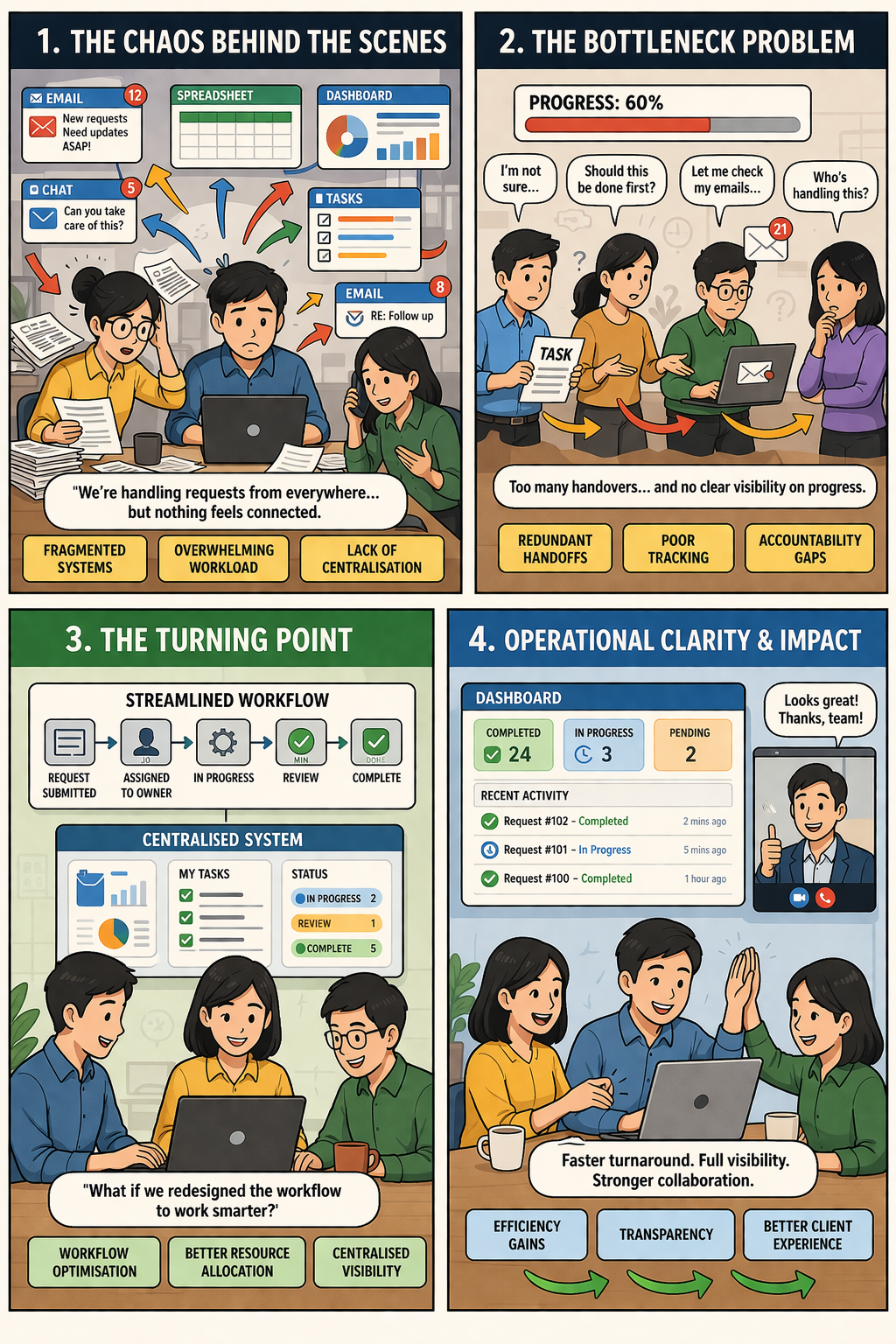
Consider the following scenario: A team is overwhelmed by scattered incoming requests from multiple channels, resulting in unclear ownership or progress. As confusion and bottlenecks build, they take a step back to rethink their workflow and streamlining processes. With a more structured system in place, the team moves from chaos to clarity, achieving faster turnaround times, stronger collaboration, and better client experience.
Creating Sustainable Operational Value Through Continuous Improvement
Enhancing administrative efficiency requires sustained effort rather than a single initiative. As organisational requirements change, it is essential to regularly assess and optimise processes to maintain their effectiveness. Ongoing evaluation enables organisations to modify workflows and resource allocation strategies in response to shifting demands and priorities.
The benefits of this approach are tangible. Organisations often see faster turnaround times for administrative requests, more efficient workflows across projects, improved visibility of task progress and stronger collaboration with client or stakeholder teams. By embedding continuous improvement into administrative operations, organisations can realise long-term value while reinforcing a disciplined approach to optimal resource allocation.
Ready to optimise workflows at scale?
Explore our Administrative Processing & Operations Services to understand how structured workflows enable more effective resource allocation at scale.