



Across both public and private sectors organisations are embracing AI to improve efficiency, reduce operational costs and deliver faster customer service. From chatbots and virtual assistants to workflow automation and agent-assist tools, AI is increasingly becoming part of day-to-day customer operations.
Yet as AI adoption grows, so does a critical question: What separates organisations that achieve meaningful customer experience improvements from those that simply deploy more technology?
The answer lies in trust. Not trust in AI itself, but trust in the systems, processes, people and governance that surround it. Organisations that view AI as part of a broader service transformation strategy are often better positioned to deliver sustainable outcomes than those treating it as a standalone technology initiative.
Why CX Transformation Has Become More Challenging
Customer expectations continue to rise. Whether engaging with a bank, healthcare provider, government agency, or customer service team, people expect faster resolutions, smoother journeys, and consistent experiences across both digital and human channels.


As a result, doing more with the same resources is becoming increasingly difficult. AI offers significant opportunities to help bridge this gap. However, technology alone rarely solves underlying service challenges. Many customer frustrations originate from fragmented processes, disconnected systems, unclear ownership or poorly designed customer journeys. Applying AI on top of these issues often accelerates inefficiencies rather than eliminating them.
The Five Foundations of Trusted AI in CX
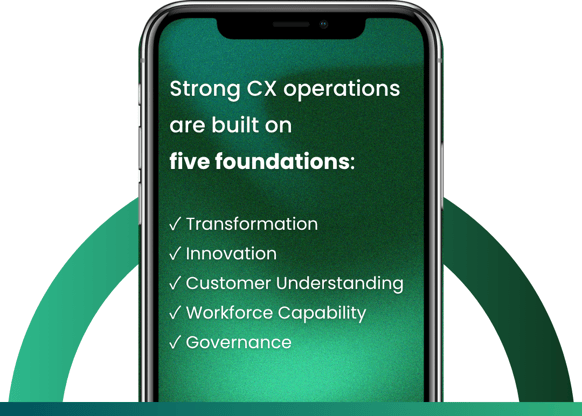
As AI becomes more embedded in service delivery organisations should consider five critical questions:
1. Can They Transform?
Technology is relatively easy to acquire. Transforming service delivery is considerably harder. Successful transformation requires alignment across:
- Process redesign
- Workforce readiness
- Data and insights
- Operational workflows
- Continuous improvement practices
The objective should not be technology adoption for its own sake. Instead organisations should focus on measurable improvements in customer outcomes, service efficiency and operational performance.
2. Do They Innovate Safely?
Innovation should enhance service delivery without introducing unnecessary risk. Leading organisations are increasingly exploring:
- AI-assisted customer engagement
- Intelligent automation
- Agent-assist capabilities
- Data analytics platforms
- Workflow orchestration tools
However, innovation only creates long-term value when supported by governance, testing, validation and operational readiness. The challenge is no longer whether organisations can innovate. It is whether they can innovate responsibly.
3. Do They Understand Customers?
Modern customer experience extends far beyond the contact centre. Every policy, process, digital channel and service touchpoint contributes to the overall customer experience. Organisations that consistently deliver positive outcomes typically invest significant effort in understanding:
- Customer expectations
- Friction points
- Service failures
- Moments that matter
This deeper understanding enables organisations to make decisions based not only on operational efficiency, but also on customer outcomes.
4. Can They Sustain Quality?
Technology can improve consistency. People sustain excellence. As customer expectations evolve organisations need more than new tools. They need a workforce that can adapt, learn and continuously improve. Key enablers include:
- Ongoing coaching
- Skills development
- Knowledge sharing
- Structured quality programmes
- Service excellence initiatives
In increasingly automated environments, human capabilities often become even more important, particularly when handling complex, sensitive or high-impact interactions.
5. Is It Governed by Standards?
Trust cannot exist without accountability. As AI becomes more integrated into customer operations organisations are increasingly focused on questions such as:
- How is quality measured?
- How are decisions monitored?
- How are customer outcomes evaluated?
- How is continuous improvement maintained?
Established frameworks such as COPC provide structured approaches to operational excellence, quality management and customer experience performance. Governance helps ensure that service improvements remain measurable, repeatable and sustainable long after deployment.
Why the Future of CX Is Human + AI
The strongest customer experience operations are not built on technology alone. They combine the strengths of both AI and human expertise.
.png?width=496&height=571&name=CX%20AI%20Adoption_Industry%20Insights%20and%20Trends%20(1).png)
Together, they create a service model that is more scalable, resilient and customer-centric than either could achieve independently. Rather than replacing people, AI enables service teams to focus on the interactions where human expertise delivers the greatest value.
Building Public-Ready Service Delivery
For public-facing and highly regulated environments, success is not measured solely by efficiency. It is measured by trust. Citizens and customers expect services that are:
- Reliable
- Accessible
- Consistent
- Secure
- Transparent
Meeting these expectations requires more than deploying AI tools. It requires a carefully balanced approach that combines transformation, innovation, customer understanding, workforce capability and governance. When these foundations work together organisations can move beyond automation and towards something far more valuable: trusted, human-centred service delivery at scale.
.png?width=916&height=416&name=CX%20AI%20Adoption_Industry%20Insights%20and%20Trends%20(2).png)
AI may be changing how services are delivered, but it is not changing what customers value most. People still want experiences that are efficient, reliable and trustworthy. The organisations that succeed in the next generation of customer experience will not necessarily be those implementing the most AI. They will be the ones creating the strongest partnership between people, processes and technology. Because ultimately, the future of CX is not Human or AI. It is Human + AI.
Ready to explore what Trusted AI could look like for your organisation?
Explore our Customer Experience solutions and learn how we help organisations deliver future-ready service experiences.